The Week That Shook the Foundation: Gold Surges Past $4,700 as Consumer Confidence Collapses and the Strait of Hormuz Burns
WiseGold Weekly Pulse | May 8, 2026
Coverage Period: May 1, 2026 (00:00:00 EST) to May 8, 2026 (11:00:00 EST)
WiseGold Capital partners with advisors to assist them in managing assets for their clients. WiseGold Capital is not an asset manager or financial advisor; it is a consulting and logistics firm. Nothing in this publication constitutes investment advice.
Executive Summary
The week was defined by a complex interplay of robust U.S. labor data, persistent geopolitical volatility in the Middle East, and shifting monetary policy expectations. The Federal Reserve maintained its benchmark rate at 3.50% to 3.75% during Jerome Powell’s final meeting as Chair, with hawkish dissents highlighting concerns over energy-driven inflation. The U.S. economy added 115,000 jobs in April, surpassing consensus estimates, while the University of Michigan Consumer Sentiment Index plummeted to an all-time low of 48.2, driven largely by surging gasoline prices linked to the U.S.-Iran conflict. Precious metals demonstrated resilience, with gold rebounding strongly to test the $4,750 per ounce level as safe-haven demand accelerated amid the fragile Strait of Hormuz ceasefire. Equity markets reached record highs before pulling back, masking underlying economic anxieties.
Key Takeaways
- Labor Market Resilience: April nonfarm payrolls increased by 115,000, demonstrating sustained economic momentum despite elevated borrowing costs.
- Geopolitical Premium: The U.S.-Iran conflict in the Strait of Hormuz continues to inject a significant risk premium into energy and precious metals markets.
- Monetary Policy Divergence: The Federal Reserve held rates steady with a hawkish tilt, while the European Central Bank signaled a data-dependent approach for June.
- Consumer Sentiment Collapse: Record-low consumer sentiment highlights the growing strain of energy inflation on household economic outlooks.
- Gold as Strategic Anchor: Strong central bank purchases and positive ETF flows reinforce gold’s role as a critical portfolio diversifier.
Market & Macro Week-in-Review Timeline
- Fri May 1: President Trump formally notified Congress that hostilities with Iran were “terminated,” citing a lack of fire exchange since April 7, though 15,000 U.S. troops remained deployed in the Strait of Hormuz region [1]. The administration also announced plans to increase tariffs on European Union cars and trucks to 25% [2].
- Mon May 4: Equity markets experienced a sharp selloff, with the Dow Jones Industrial Average falling 557 points, as the fragile U.S.-Iran ceasefire appeared to unravel following Iranian drone and missile launches at U.S. positions [3].
- Tue May 5: Wall Street rallied, with the Dow reclaiming the 49,000 level and the S&P 500 and Nasdaq topping prior records, fueled by easing oil prices and strong corporate earnings reports [4]. The ISM Services PMI registered 53.6%, marking the 22nd consecutive month of expansion [5].
- Wed May 6: The S&P 500 and Nasdaq surged to record-high closes, driven by optimism surrounding artificial intelligence and hopes for a resolution in the Middle East conflict [6].
- Thu May 7: A U.S. Court of International Trade panel ruled President Trump’s 10% global tariff illegal, dealing a significant blow to the administration’s trade policy [7]. The U.S. military intercepted Iranian attacks on three Navy destroyers transiting the Strait of Hormuz, responding with strikes on Iranian military facilities [8].
- Fri May 8: The Bureau of Labor Statistics reported an increase of 115,000 nonfarm payrolls for April, significantly beating the 55,000 consensus estimate [9]. (10:00) The University of Michigan preliminary Consumer Sentiment Index fell to an all-time low of 48.2, driven by surging gas prices [10].
Thematic Deep Dives
Macro & Monetary Policy
The Federal Reserve maintained the federal funds rate at 3.50% to 3.75% during the April 28–29 FOMC meeting, marking Jerome Powell’s final session as Chair before Kevin Warsh assumes the role on May 15.
- Three regional bank presidents dissented over forward guidance language that suggested eventual rate cuts.
- Boston Fed President Susan Collins expressed strong support for the rate hold but preferred adjusting the statement to remove the presumption of imminent easing [11].
- Market participants remain divided on the policy outlook, with some brokerages projecting no rate cuts through 2026 [12].
The hawkish dissents underscore the central bank’s focus on persistent inflationary pressures, particularly those stemming from energy markets. The transition to a new Fed Chair introduces a layer of policy uncertainty, though the current consensus leans heavily toward a “higher for longer” regime.
Inflation & Growth Data
Economic indicators presented a mixed picture, balancing robust labor market performance with collapsing consumer confidence.
- April nonfarm payrolls increased by 115,000, while the unemployment rate held steady at 4.3% [9].
- The ISM Manufacturing Prices Paid index surged to 84.6 in April, well above market expectations, signaling intensifying input cost pressures [13].
- The preliminary May University of Michigan Consumer Sentiment Index plummeted to a record low of 48.2, with one-year inflation expectations easing slightly to 4.5% [10].
The divergence between solid job creation and record-low consumer sentiment highlights the disproportionate impact of energy inflation on household psychology. The surge in manufacturing prices paid suggests that inflationary pressures remain entrenched in the supply chain.
Rates & Yield Curve Dynamics
Treasury yields experienced moderate volatility, balancing strong economic data against geopolitical safe-haven flows.
- The 10-year Treasury yield traded in a range of 4.37% to 4.40%, easing slightly following the robust jobs report [14].
- The 2-year Treasury yield hovered near 3.88%, maintaining the inverted yield curve structure [15].
- The 30-year Treasury yield climbed closer to the 5.00% threshold amid concerns over long-term borrowing costs [16].
The persistent inversion of the yield curve continues to signal underlying economic caution, even as equity markets reach new highs. The slight easing of the 10-year yield following the jobs report suggests that markets had already priced in significant labor market strength.
FX & Dollar Landscape
The U.S. dollar exhibited weakness despite the strong labor market data, influenced by shifting global monetary policy expectations and geopolitical developments.
- The U.S. Dollar Index (DXY) fell to approximately 98.00, extending a recent decline [17].
- The Japanese yen remained under pressure, prompting the Bank of Japan to maintain its policy rate at 0.50% following a series of hikes in 2024 and 2025 [18].
- The European Central Bank signaled a data-dependent approach for its June meeting, with some officials suggesting the ECB could diverge from the global trend [19].
The dollar’s inability to capitalize on strong domestic data suggests that currency markets are increasingly focused on the potential for a steeper fall if geopolitical tensions ease or if other central banks adopt more hawkish stances relative to the Federal Reserve.
Energy & Broader Commodities Context
Energy markets remained highly volatile, driven entirely by the escalating conflict in the Strait of Hormuz.
- Brent crude oil futures fluctuated significantly, settling near $100 per barrel after briefly surging above $109 earlier in the week [20].
- U.S. retail gasoline prices reached a record national average of $4.45 per gallon, directly impacting consumer sentiment [21].
- Copper prices approached record highs, trading above $6.10 per pound, reflecting strong industrial demand and supply constraints [22].
The Strait of Hormuz, a critical chokepoint for approximately 20% of global oil supply, remains the primary catalyst for energy market instability. The resulting surge in gasoline prices is acting as a regressive tax on consumers, complicating the macroeconomic outlook.
Precious Metals Focus
Precious metals demonstrated robust performance, supported by safe-haven demand and structural buying.
- Gold traded roughly $4,500 to $4,750/oz during the period, rebounding strongly to test key resistance levels [23].
- Silver traded roughly $73.00 to $82.00/oz, outperforming gold on a percentage basis [24].
- Platinum traded roughly $1,970 to $2,094/oz, while palladium traded roughly $1,484 to $1,532/oz [25].
- Global physically backed gold ETFs recorded inflows of $6.6 billion in April, flipping year-to-date flows positive [26].
- Central banks added a net 244 tonnes of gold to their reserves in the first quarter of 2026, the highest level since late 2024 [27].
- Speculative positioning in gold futures has been trimmed, reducing the risk of a sharp liquidation event [28].
The combination of positive ETF flows and sustained central bank purchases provides a strong structural foundation for gold prices. The metal’s ability to rebound sharply amid geopolitical stress reinforces its role as a premier safe-haven asset.
Credit & Liquidity
Credit markets exhibited resilience, though underlying vulnerabilities remain a focus for institutional investors.
- Credit spreads tightened alongside strong equity returns, reinforcing a “risk-on” environment [29].
- High-yield bond spreads currently sit approximately 200 basis points below their long-run average, creating a thin margin for error [30].
- The Financial Stability Board released a report highlighting vulnerabilities in the $1 trillion private credit market, particularly concerning liquidity mismatches [31].
The tightness in corporate credit spreads suggests that investors are not demanding significant compensation for default risk, despite the elevated interest rate environment. However, the growing scrutiny of private credit liquidity indicates potential systemic risks beneath the surface.
Equity & Volatility Sentiment
U.S. equity markets achieved historic milestones before consolidating, driven by a narrow leadership of technology and artificial intelligence stocks.
- The S&P 500 and Nasdaq Composite reached record-high closes on May 6, fueled by strong corporate earnings and AI optimism [6].
- The Dow Jones Industrial Average briefly traded above the 50,000 mark before retreating [32].
- The CBOE Volatility Index (VIX) drifted lower to the 17.00 level, indicating a reduction in near-term fear [33].
The equity market’s resilience in the face of geopolitical conflict and hawkish monetary policy is notable. However, the reliance on a concentrated group of mega-cap technology stocks and the disconnect between market exuberance and consumer pessimism warrant careful monitoring.
Geopolitics & Strategic Risk
The U.S.-Iran conflict dominated the geopolitical landscape, creating significant uncertainty across global markets.
- Despite President Trump’s declaration that hostilities were “terminated,” military engagements continued in the Strait of Hormuz [1].
- The U.S. military intercepted Iranian attacks on Navy vessels and responded with targeted strikes [8].
- A U.S. trade court struck down the administration’s 10% global tariff, complicating the broader trade policy agenda ahead of a planned summit with China [7].
The persistent volatility in the Middle East represents the most acute near-term risk to the global economy, primarily through the transmission mechanism of energy prices. The legal challenges to U.S. trade policy add another layer of complexity to international relations.
Structural & Long-Term Themes
The current environment is accelerating several long-term structural shifts in the global financial system.
- The “quiet erosion of central bank independence” was highlighted in a recent European Central Bank speech, reflecting growing political pressure on monetary authorities [34].
- The trend of de-dollarization continues, with gold increasingly viewed as a strategic reserve asset capable of overtaking dollar reserves in global trust [35].
- The transition to a new Federal Reserve Chair introduces potential shifts in the long-term approach to inflation targeting and balance sheet management.
These structural themes suggest a fundamental realignment of global capital flows, with tangible assets and non-fiat reserves gaining prominence in institutional portfolios.
Cross-Asset Interlinkages
- Surging energy prices driven by the Strait of Hormuz conflict directly contributed to the record-low University of Michigan Consumer Sentiment reading, highlighting the transmission of geopolitical risk to domestic economic psychology.
- The robust April jobs report provided the Federal Reserve with the necessary economic cover to maintain its hawkish stance, keeping short-term Treasury yields elevated.
- The tightening of high-yield credit spreads alongside record equity highs indicates a broad “risk-on” sentiment that appears disconnected from the underlying geopolitical and inflationary realities.
- The weakness in the U.S. Dollar Index, despite strong domestic labor data, provided a supportive macroeconomic backdrop for the strong rebound in precious metals prices.
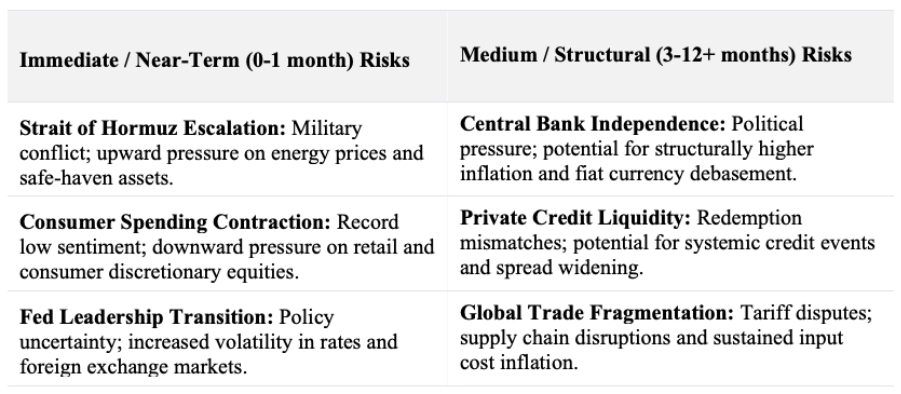
Risk Matrix Snapshot
Scenario Watch & Forward Catalysts
- U.S. Consumer Price Index (CPI) Release (Base Probability): The upcoming inflation data will be critical in shaping expectations for the June FOMC meeting. A hotter-than-expected print would reinforce the “higher for longer” narrative, potentially acting as a headwind to bullion.
- Strait of Hormuz Ceasefire Breakdown (Elevated Probability): Further military escalation resulting in a sustained disruption of oil shipments would likely trigger a severe energy shock, accelerating safe-haven flows into precious metals.
- U.S.-China Trade Summit (Base Probability): The planned meeting between President Trump and Chinese leadership will be closely monitored for signs of trade deal compliance or further tariff escalation.
Portfolio Context & Implications
The current macroeconomic environment, characterized by entrenched inflation, geopolitical instability, and record-high equity valuations, underscores the importance of strategic diversification. The disconnect between robust financial asset performance and deteriorating consumer sentiment suggests a fragile equilibrium. In this context, assets that exhibit low correlation to traditional equities and bonds, while providing a hedge against currency debasement and geopolitical shocks, remain critical components of a resilient portfolio architecture.
Precious Metals Strategic Thesis
Diversification Attribute
Gold’s performance during the recent equity market volatility and geopolitical stress reaffirms its role as a premier portfolio diversifier. Its ability to generate positive returns during periods of acute uncertainty provides a necessary counterbalance to highly correlated financial assets.
Wealth Protection & Purchasing Power
With the ISM Manufacturing Prices Paid index surging and energy costs acting as a regressive tax, the threat of sustained inflation remains elevated. Precious metals have historically served as a reliable mechanism for preserving purchasing power when fiat currencies face inflationary pressures.
Drawdown Mitigation & Crisis Optionality
The escalating conflict in the Strait of Hormuz and the potential for a broader energy shock highlight the need for crisis optionality. Gold’s high liquidity and universal acceptance make it an ideal asset for mitigating severe portfolio drawdowns during systemic events.
Structural Demand Drivers
The return of positive global ETF flows, combined with the highest level of central bank gold purchases since 2024, provides a robust structural foundation for the precious metals complex. This sustained institutional and sovereign demand indicates a long-term shift in global reserve preferences.
Allocation Framing
Academic research and historical performance data consistently support the inclusion of precious metals in a diversified portfolio. While specific allocations vary based on individual risk tolerance and investment horizons, a strategic position in gold and silver can enhance risk-adjusted returns and provide a critical layer of financial resilience.
Summary Capsule
- Macro Pulse: The U.S. economy added 115,000 jobs in April, demonstrating resilience, while consumer sentiment plummeted to a record low of 48.2 due to surging gas prices.
- Metals Stance: Gold rebounded strongly to test $4,750/oz, supported by safe-haven demand, positive ETF flows, and robust central bank purchases.
- Risk Tone: Equity markets reached record highs before consolidating, while credit spreads remained tight, indicating a “risk-on” sentiment that contrasts with geopolitical realities.
- Positioning Nuance: Speculative length in gold futures has been trimmed, reducing the risk of a sharp liquidation event and providing a healthier foundation for future price appreciation.
- Forward Watch: Markets are closely monitoring the fragile U.S.-Iran ceasefire in the Strait of Hormuz and the upcoming transition of Federal Reserve leadership.
- Structural Theme: The continued accumulation of gold by central banks and the vulnerabilities in the private credit market highlight a shifting global financial architecture.
Source List
[1] Reuters — White House says Iran war ‘terminated’ as war powers deadline arrives — May 1, 2026 — https://www.reuters.com/world/asia-pacific/white-house-says-iran-war-terminated-war-powers-deadline-arrives-2026-05-01/ [2] CNBC — President Trump: Increasing tariffs on EU for cars and trucks to 25 percent next week — May 1, 2026 — https://www.cnbc.com/video/2026/05/01/president-trump-increasing-tariffs-on-eu-for-cars-and-trucks-to-25-percent-next-week.html [3] CNBC — Stock market news for May 4, 2026 — May 4, 2026 — https://www.cnbc.com/2026/05/03/stock-market-today-live-updates.html [4] NBC Palm Springs — Wall Street Rallies to New Records: Dow Reclaims 49000 — May 5, 2026 — https://www.nbcpalmsprings.com/2026/05/05/wall-street-rallies-to-new-records-dow-reclaims-49000-as-easing-oil-prices-and-strong-earnings-fuel-may-5-surge [5] PR Newswire — Services PMI at 53.6%; April 2026 ISM Services PMI Report — May 5, 2026 — https://www.prnewswire.com/news-releases/services-pmi-at-53-6-april-2026-ism-services-pmi-report-302761674.html [6] Reuters — S&P 500 and Nasdaq notch records; AMD results spark AI optimism — May 6, 2026 — https://www.reuters.com/business/us-stock-index-futures-rise-middle-east-peace-hopes-ai-optimism-2026-05-06/ [7] New York Times — Trade Court Rules Trump’s 10% Global Tariff Is Illegal — May 7, 2026 — https://www.nytimes.com/2026/05/07/business/economy/trump-global-tariff-ruled-illegal.html [8] AP News — US military says it intercepted Iranian attacks on 3 Navy ships — May 7, 2026 — https://apnews.com/article/iran-us-israel-war-may-7-2026-fdc6d2ae9396377919c967746fa9996b [9] Reuters — US job growth beats expectations in April; unemployment rate steady at 4.3% — May 8, 2026 — https://www.reuters.com/world/us/us-job-growth-beats-expectations-april-unemployment-rate-steady-43-2026-05-08/ [10] CNBC — Consumer sentiment falls to fresh record low in May as surging gas prices hit outlook — May 8, 2026 — https://www.cnbc.com/2026/05/08/consumer-sentiment-falls-to-fresh-record-low-in-may-as-surging-gas-prices-hit-outlook.html [11] TheStreet — Another Fed official signals strong warning on rate path — May 8, 2026 — https://www.thestreet.com/fed/another-fed-official-signals-strong-warning-that-2026-interest-rate-outlook-may-need-to-include-hikes [12] Reuters — Top brokerages sharply split on Fed’s 2026 policy outlook — May 4, 2026 — https://www.reuters.com/business/finance/wall-street-brokerages-pencil-fed-rate-cuts-mid2026-2026-05-01/ [13] Trading Economics — United States ISM Manufacturing Prices Paid — May 2, 2026 — https://tradingeconomics.com/united-states/ism-manufacturing-prices [14] CNBC — 10-year Treasury yield eases despite big jobs number beat — May 8, 2026 — https://www.cnbc.com/2026/05/08/treasury-yields-edge-lower-as-traders-await-key-jobs-data.html [15] StreetStats — U.S. Treasury Yield Curve — May 6, 2026 — https://streetstats.finance/rates/treasuries [16] Morningstar — There’s a new worry keeping Treasury yields and borrowing costs higher — May 7, 2026 — https://www.morningstar.com/news/marketwatch/20260507533/theres-a-new-worry-keeping-treasury-yields-and-borrowing-costs-higher [17] RootData — The US Dollar Index DXY fell to 98, down 0.27% for the day — May 8, 2026 — https://www.rootdata.com/news/633190 [18] CNBC — Japan’s battle against the weak yen is colliding with economic reality — May 7, 2026 — https://www.cnbc.com/2026/05/07/japan-yen-intervention-boj-rate-gap-currency-pressure.html [19] Financial Times — ECB should keep its options open for June meeting, says Villeroy — May 7, 2026 — https://www.ft.com/content/c89188d0-3898-4f2b-92f2-d43ca4a30905 [20] Reuters — Oil prices fall 4% as fragile US-Iran ceasefire holds — May 5, 2026 — https://www.reuters.com/business/energy/us-crude-eases-1-traders-weigh-supply-risks-2026-05-04/ [21] Fox Business — National average gas price reaches $4.45 before summer driving season — May 3, 2026 — https://www.foxbusiness.com/politics/national-average-gas-price-reaches-4-45-before-summer-driving-season [22] Trading Economics — Copper is down by 5.61% — May 7, 2026 — https://tradingeconomics.com/commodity/copper/news/548917 [23] Fortune — Current price of gold: May 7, 2026 — May 7, 2026 — https://fortune.com/article/current-price-of-gold-05-07-2026/ [24] Fortune — Current price of silver as of Thursday, May 7, 2026 — May 7, 2026 — https://fortune.com/article/current-price-of-silver-5-7-2026/ [25] Texas Precious Metals — Precious Metals Update: Silver Up, PGMs Fall May 7, 2026 — May 7, 2026 — https://texmetals.com/all-news/precious-metals-market-update-5-7-2026 [26] World Gold Council — The West returns to the fold — May 7, 2026 — https://www.gold.org/goldhub/research/gold-etfs-holdings-and-flows/2026/05 [27] Advantage Gold — Central Bank Gold Buying 2026: Banks Bought 244 Tonnes in Q1 — May 7, 2026 — https://www.advantagegold.com/blog/central-bank-gold-buying-2026-banks-bought-244-tonnes-in-q1-bar-and-coin-demand-hit-its-second-highest-level-ever-the-price-dipped-they-bought-more/ [28] TradingView — Gold Futures (Jun 2026) Trade Ideas — May 5, 2026 — https://www.tradingview.com/symbols/COMEX-GC1%21/ideas/?contract=GCM2026 [29] StoneX — Credit Spreads Tighten as Risk Appetite Returns Fast — May 7, 2026 — https://www.stonex.com/en/insights/credit-spreads-tighten-as-risk-appetite-returns-fast/ [30] Yahoo Finance — Credit Spreads Are the Signal That Will Make or Break VGHY in 2026 — May 5, 2026 — https://finance.yahoo.com/markets/options/articles/credit-spreads-signal-break-vghy-150033517.html [31] Financial Stability Board — Report on Vulnerabilities in Private Credit — May 6, 2026 — https://www.fsb.org/uploads/P060526.pdf [32] Barron’s — The Dow Falls 100 Points. It Can’t Stay Above 50000. — May 7, 2026 — https://www.barrons.com/livecoverage/stock-market-news-today-050726/card/the-dow-falls-100-points-it-can-t-stay-above-50-000--gbmxvhb9nnFmNcUusL8N [33] 24/7 Wall St. — VIX Stands Firm as Fear Drains, Stocks Chase Records — May 7, 2026 — https://247wallst.com/investing/2026/05/07/vix-stands-firm-as-fear-drains-stocks-chase-records-and-earnings-keep-dip-buyers-engaged/ [34] European Central Bank — The quiet erosion of central bank independence — May 7, 2026 — https://www.ecb.europa.eu/press/key/date/2026/html/ecb.sp260507_1~d5ae988ece.en.html [35] Sprott — Gold Overtakes Dollar Reserves as Global Trust Shifts — May 6, 2026 — https://sprott.com/insights/gold-overtakes-dollar-reserves-as-global-trust-shifts/
Methodology & Notes
Data compilation for this report relies on publicly available information from credible financial news outlets, central bank communications, and market data providers. Price ranges for precious metals and commodities are approximated based on daily trading ranges within the coverage window. The coverage period extends through Friday 11:00 AM EST to ensure the inclusion of critical late-week data releases, such as the University of Michigan Consumer Sentiment report.
Disclosure
This report is for informational purposes only and does not constitute investment advice, a recommendation, an offer, or a solicitation to buy or sell any financial instrument. The views expressed are based on publicly available information believed to be reliable, but accuracy or completeness cannot be guaranteed. Past performance is not indicative of future results. Readers should conduct their own analysis and consult qualified professionals before making any financial decisions.
#WiseGold #Gold #PreciousMetals #WealthProtection #MacroEconomics #Geopolitics #FinancialResilience #FederalReserve #Iran #StraitOfHormuz #GoldInvesting #PortfolioDiversification #CentralBanks #Inflation #WealthManagement #FinancialAdvisors #MarketIntelligence #WiseGoldCapital