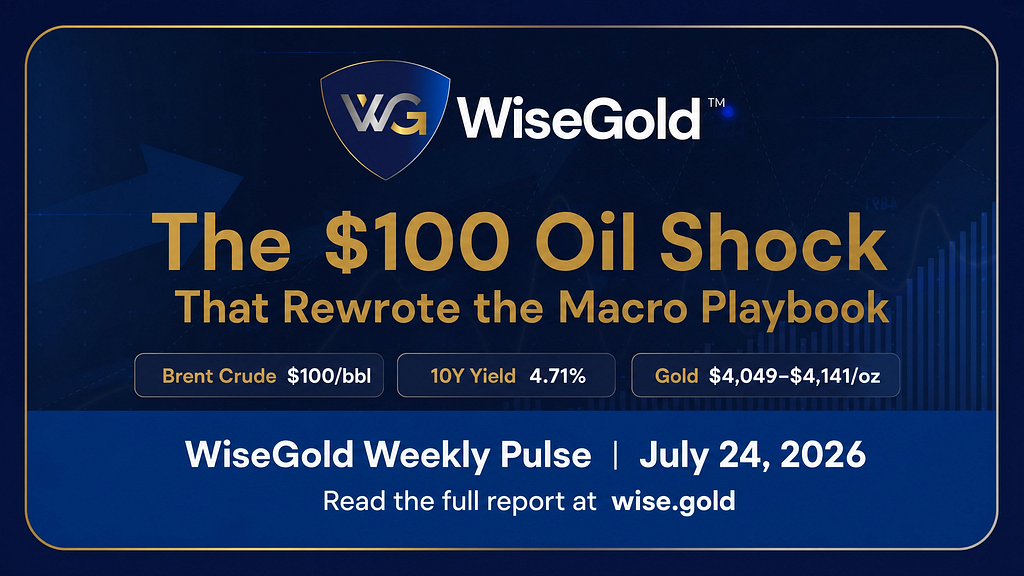
Impulsion hebdomadaire WiseGold | 24 juillet 2026
Période de couverture : 18 juillet 2026 (00:00:00 EST) au 24 juillet 2026 (11:00:00 EST)
WiseGold Capital s’associe à des conseillers pour les aider à gérer les actifs de leurs clients. WiseGold Capital n’est ni gestionnaire d’actifs ni conseiller financier ; C’est une société de conseil et de logistique. Rien dans cette publication ne constitue un conseil en investissement.
À propos de WiseGold
Le WiseGold Weekly Pulse est publié par WiseGold, une société de conseil et de logistique qui collabore avec des conseillers financiers, des family offices et des gestionnaires de fonds pour faciliter l’accès aux métaux précieux physiques dans le cadre d’un cadre plus large de préservation de patrimoine et de diversification de portefeuille. Des ressources supplémentaires, incluant des commentaires de marché de qualité institutionnelle, des contenus éducatifs sur les fondamentaux des métaux précieux et des informations sur les services de soutien de conseil de WiseGold, sont disponibles sur https://wise.gold.
Résumé exécutif
La semaine écoulée a été marquée par une forte escalade des tensions géopolitiques au Moyen-Orient et une réévaluation correspondante des marchés de l’énergie, qui a brusquement fait basculer le récit macroéconomique. Avant ces développements, des données d’inflation de juin, plus faibles que prévu, avaient nourri des attentes d’une pause de la Réserve fédérale. Cependant, les hostilités renouvelées, mises en évidence par des frappes houthis contre des pétroliers saoudiens et des nuits consécutives de frappes américaines contre l’Iran, ont propulsé le pétrole brut Brent au-dessus de 100 $/baril. Ce choc énergétique a ravivé les craintes inflationnistes, faisant grimper le rendement des obligations du Trésor américain à 10 ans à son plus haut niveau depuis janvier 2025 et freinant l’appétit pour le risque dans l’ensemble des actions. Parallèlement, le complexe des métaux précieux a connu une forte chute due à la liquidité, bien que les primes physiques restent solides.
Points clés :
- Choc énergétique : Le pétrole brut Brent a dépassé les 100 $/baril suite aux attaques des Houthis contre des pétroliers saoudiens et aux frappes américaines sur l’Iran. [1] [2]
- Pics des rendements : Le rendement des obligations du Trésor à 10 ans a atteint 4,71 %, un sommet de plusieurs années, en raison de nouvelles préoccupations liées à l’inflation. [3]
- Recalibration de la Fed : Les marchés réévaluent les trajectoires des taux en vue de la réunion du FOMC du 29 juillet, dans le contexte de la flambée pétrolière. [3]
- Recul des métaux : L’or est tombé sous la barre de 4 100 $/oz et l’argent a chuté de 3,5 %, porté par la hausse des rendements réels et un dollar plus ferme. [4]
- Résilience physique : Malgré la faiblesse du marché papier, la demande physique en lingots et les primes de pièces restent solides. [4]
Chronologie de la semaine de la semaine Market & Macro
- Samedi 18 juil. : Les plus grandes banques chinoises annoncent la fin du commerce de l’or papier à effet de détail à effet de levier à la Bourse de l’or de Shanghai, à compter du 24 juillet, marquant un virage structurel vers la demande physique. [5]
- Dim 19 juil. : Andy Burnham prête serment en tant que nouveau Premier ministre du Royaume-Uni, s’engageant à réformer l’économie dans un contexte de données du marché du travail stabilisées mais faibles. [6]
- Lun 20 juillet : Les États-Unis imposent un nouveau tarif de 50 % sur près de 20 milliards de dollars d’importations canadiennes, aggravant les tensions commerciales. [7]
- Mar 21 juillet : L’indice du dollar américain (DXY) grimpe, prêt pour une quatrième session consécutive de gains, soutenue par la hausse des rendements et des flux refuges. [8]
- Mercredi 22 juillet : L’armée américaine termine sa onzième nuit consécutive de frappes contre l’Iran ; Les prix du pétrole s’envolent. [9]
- Jeu 23 juillet : Des militants houthis frappent deux pétroliers saoudiens en mer Rouge ; Le brut Brent dépasse les 100 $/baril. Le rendement des obligations du Trésor à 10 ans atteint 4,71 %. Les premières demandes d’allocations chômage aux États-Unis chutent à 187 000, le plus bas niveau depuis 1969. L’or et l’argent se vendent fortement. [1] [3] [4] [10]
- Ven 24 juil. (10h00) : Les données PMI de S&P Global Flash aux États-Unis montrent une accélération de l’activité des services à 53,6, tandis que la production ralentit à 53,8 en raison de retards dans la chaîne d’approvisionnement. [11]
Plongées thématiques profondes
Politique macroéconomique et monétaire
Le paysage de la politique monétaire a brusquement changé cette semaine. Plus tôt, des données plus faibles de l’IPC et du PCE de juin avaient conduit les marchés à prévoir avec confiance un maintien des taux pour la réunion du FOMC du 29 juillet à venir. Cependant, la hausse soudaine des prix du pétrole a réintroduit des risques haussiers d’inflation. Bien qu’un maintien en juillet reste le cas de base, l’attention s’est entièrement portée sur les prévisions prospectives de la Fed et la possibilité d’une hausse en septembre. La BCE est restée stable le 23 juillet, adoptant une approche dépendante des données tout en notant l’impact inflationniste du choc énergétique. [12] La Banque du Japon devrait largement maintenir son taux clé à 1 % la semaine prochaine, bien que la faiblesse du yen maintint les risques d’inflation élevés. [13]
Données sur l’inflation et la croissance
Les données économiques présentaient une image mitigée, équilibrant une activité résiliente avec les contraintes émergentes de l’offre. Les premières demandes d’allocations chômage américaines ont chuté à 187 000, soulignant la tension du marché du travail. [10] Le S&P Global Flash U.S. PMI pour juillet indiquait une accélération des services (53,6), mais une légère modération dans la fabrication (53,8), les répondants citant de nouveaux retards dans la chaîne d’approvisionnement et des pressions sur les prix liées au conflit au Moyen-Orient. [11] Le sentiment des consommateurs, selon la lecture préliminaire de juillet de l’Université du Michigan, s’est amélioré à 54,4, bien qu’il reste discret par rapport aux moyennes historiques en raison de la persistance des prix. [14]
Taux et dynamique de la courbe des taux
Les marchés du Trésor ont réagi violemment au choc énergétique et aux données solides du marché du travail. Le rendement des obligations du Trésor américain à 10 ans a bondi à 4,71 %, son plus haut niveau depuis janvier 2025, poussé par la crainte que la hausse des prix du pétrole n’ancre l’inflation et oblige la Fed à maintenir une politique restrictive plus longtemps. [3] Le rendement sur 2 ans a également grimpé, atteignant 4,36 %, reflétant une réévaluation des attentes de taux à court terme. [3] Cette dynamique d’accentuation baissière souligne la sensibilité accrue du marché aux chocs géopolitiques de l’offre.
Paysage des changes et du dollar
Le dollar américain a affirmé sa domination cette semaine, profitant d’une conjonction de rendements en hausse, de données nationales solides et d’une demande de refuges. L’indice DXY a progressé vers 101,4, enregistrant sa plus longue série de gains quotidiens depuis la mi-mai. [8] Le yen a dépassé 163 par dollar, ce qui a entraîné des avertissements d’intervention des autorités japonaises. [8] Le dollar canadien a également reculé après l’annonce de nouveaux tarifs américains sur les produits canadiens. [8]
Contexte de l’énergie et des matières premières plus larges
Les marchés énergétiques étaient l’épicentre de la volatilité mondiale. Les contrats à terme sur le Brent ont dépassé les 100 $/baril, augmentant environ 7 % suite à des rapports d’attaques de drones et de missiles houthis contre des pétroliers saoudiens en mer Rouge. [1] Cette escalade, combinée aux frappes américaines continues sur des cibles iraniennes, a gravement perturbé la navigation à travers des points d’étranglement critiques. Le brut WTI a également progressé, se stabilisant au-dessus de 92 $/baril. [1] Les prix du gaz naturel sont restés relativement stables, les contrats à terme Henry Hub se négociant près de 2,89 $/MMBtu. [15]
Focus sur les métaux précieux
Le complexe des métaux précieux a subi une forte pression, les rendements en hausse et un dollar plus fort dépassant la demande de refuges.
- Or : Échangé entre environ 4 049 $ et 4 141 $/oz. Les prix au comptant ont fortement chuté en fin de semaine, passant sous les 4 100 $/oz alors que le coût d’opportunité de détenir des actifs à rendement zéro augmentait. [4]
- Argent : Échangé entre environ 57,33 $ et 60,01 $/oz. L’argent a affiché son bêta caractéristique élevé, chutant de plus de 3,5 % à 58,38 $/oz, repoussant le ratio or-argent au-dessus de 70. [4]
- Platine : Baisse à environ 1 608 $/oz. [4]
- Pallade : A reculé à environ 1 276 $/oz. [4]
Malgré la chute du marché du papier, les primes de pièces physiques et de lingots sont restées solides, indiquant une forte demande sous-jacente de la part des acheteurs physiques profitant de cette baisse. [4] La décision de la Chine de mettre fin au commerce de détail de l’or papier sur la SGE met davantage en lumière un virage structurel vers l’accumulation physique. [5]
Crédit & Liquidité
Les marchés du crédit ont montré des signes de stress face à la volatilité des taux. L’enquête de la BCE sur les prêts bancaires a rapporté un léger durcissement des critères de crédit pour les prêts commerciaux et les hypothèques au deuxième trimestre. [12] Aux États-Unis, les spreads des obligations d’entreprise se sont légèrement élargis alors que les investisseurs exigeaient une compensation plus élevée pour les doubles risques de taux plus élevés et d’instabilité géopolitique.
Actions et sentiment de volatilité
Les actions américaines ont connu une semaine mouvementée, cédant finalement à la pression des rendements plus élevés. Alors que les échanges en début de semaine ont vu le S&P 500 tenter de consolider, la hausse des prix du pétrole et le rendement à 10 ans ont déclenché une large rotation de risque contre le risque. Le VIX, qui avait été maîtrisé, a grimpé alors que les investisseurs cherchaient une protection à la baisse avant la réunion du FOMC et au cœur de l’escalade du conflit au Moyen-Orient.
Géopolitique et Risque Stratégique
Le risque géopolitique est sans équivoque revenu au premier plan. Le conflit entre les États-Unis et l’Iran s’est considérablement intensifié, les États-Unis menant leur onzième nuit consécutive de frappes. [9] Les attaques des Houthis contre les pétroliers saoudiens en mer Rouge représentent un élargissement dangereux du conflit, menaçant directement les approvisionnements énergétiques mondiaux. [1] Parallèlement, la politique commerciale américaine est devenue plus agressive, comme en témoignent les nouveaux tarifs de 50 % sur les importations canadiennes. [7]
Thèmes structurels et à long terme
Le changement structurel des marchés mondiaux de l’or continue de se dérouler. L’arrêt du commerce de détail de l’or papier à la Bourse de Shanghai marque une avancée réglementaire significative vers des marchés physiques entièrement alloués. [5] De plus, l’accumulation des banques centrales reste un thème dominant, le Conseil mondial de l’or notant que 89 % des gestionnaires de réserves prévoient une croissance des réserves d’or des banques centrales mondiales au cours de l’année à venir. [16]
Interliaisons inter-actifs
- Pétrole & rendements : La hausse du Brent brut au-dessus de 100 $/baril a directement alimenté les attentes d’inflation, agissant comme principal catalyseur de la hausse du rendement du Trésor à 10 ans à 4,71 %.
- Rendements & or : La forte hausse des rendements nominaux et réels a augmenté le coût d’opportunité de la détention de lingots, déclenchant la chute du marché du papier en or et en argent malgré le risque géopolitique accru.
- Dollar & matières premières : Le dollar américain en renforcement, porté par les écarts de rendement et les flux de refuge, a exercé une forte pression à la baisse sur le complexe des matières premières, l’énergie étant l’exception notable en raison des menaces aiguës liées à l’offre.
- Géopolitique et actions : L’élargissement du conflit au Moyen-Orient a perturbé la phase de consolidation du marché boursier, entraînant une rotation des actifs à risque à mesure que le VIX montait.
Aperçu de la matrice de risques
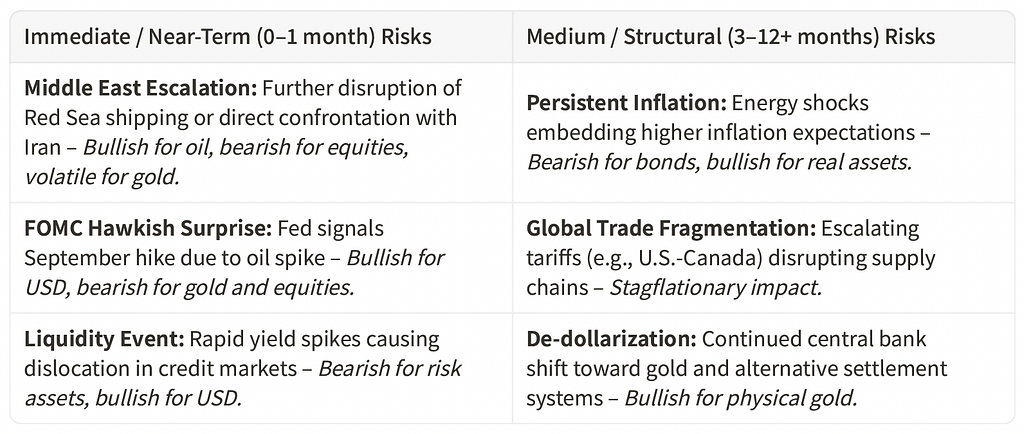
Surveillance de scénario & Catalyseurs avancés
- Décision sur les taux du FOMC (29 juillet) : Probabilité de base : Maintenir. Probabilité élevée : Prévision prospective agressive indiquant une hausse en septembre. Sensibilité aux métaux précieux : Une surprise belliciste = vent de face potentiel pour les lingots.
- Données d’inflation du PCE aux États-Unis (30 juillet) : Probabilité de base : Accélération modeste. Sensibilité aux métaux précieux : Une impression à chaud valide des rendements plus élevés, mettant l’or sous pression.
- Réunion de politique monétaire de la Banque du Japon (31 juillet) : Probabilité de base : Maintien à 1 %. Probabilité élevée : Un rythme de hausse plus rapide des taux indique une faiblesse du yen.
Contexte et implications du portefeuille
Les événements de la semaine passée mettent en lumière la fragilité du récit de la « désinflation et baisses de taux ». La réapparition soudaine d’un choc énergétique démontre à quelle vitesse les conditions macroéconomiques peuvent évoluer. Dans ce contexte, le récent recul des métaux précieux peut être vu à travers le prisme d’une diversification stratégique. Bien que des rendements réels plus élevés présentent un vent contraire à court terme, les moteurs sous-jacents de la thèse de l’or, l’instabilité géopolitique, la domination budgétaire et l’accumulation des banques centrales, restent solides. La divergence entre les ventes en baisse du marché papier et les primes physiques des entreprises suggère que les accumulateurs de base utilisent la volatilité pour renforcer leurs positions.
Thèse stratégique sur les métaux précieux
Attribut de diversification
La nature non corrélée de l’or reste vitale. Bien qu’elle ait été vendue en même temps que les actions cette semaine en raison d’un choc de liquidité et de rendement, sa trajectoire à long terme est dictée par des facteurs fondamentaux différents de ceux des actifs financiers traditionnels.
Protection de la richesse et pouvoir d’achat
La résurgence des prix du pétrole au-dessus de 100 $/baril souligne la menace persistante pesant sur le pouvoir d’achat. Les métaux précieux physiques servent de couverture historique contre la dévaluation des fiats provoquée par l’inflation de l’offre.
Atténuation du retrait et optionnalité de crise
L’escalade du conflit au Moyen-Orient souligne la nécessité d’une option de crise. Les lingots physiques, détenus en dehors du système bancaire, fournissent une liquidité non entravée lors de périodes de stress géopolitique ou financier sévère.
Moteurs de la demande structurelle
L’accumulation des banques centrales continue sans relâche, et les changements réglementaires, comme le rejet de la Chine de l’or papier, renforcent la primauté du marché physique. Ces forces structurelles offrent un plancher durable sous les prix.
Cadre d’allocation
D’un point de vue stratégique, les métaux précieux fonctionnent comme une couche fondamentale de résilience financière. Leur rôle n’est pas de maximiser le rendement à court terme, mais d’assurer la préservation de la richesse à long terme dans un contexte de volatilité systémique et de régimes monétaires changeants. WiseGold Capital collabore avec des conseillers pour les aider à gérer les actifs de leurs clients, en fournissant la logistique et le conseil nécessaires à la mise en œuvre de ces stratégies.
Capsule Résumée
- Pulse macro : Le récit est brusquement passé de la désinflation à une nouvelle crainte d’inflation, alimentée par un choc énergétique sévère.
- Position des métaux : Les marchés du papier ont connu une forte chute basée sur les rendements, mais la demande physique et les primes restent résilientes.
- Ton du risque : Le sentiment de dépourvu du risque est omniprésent alors que les actions reculent et que le VIX augmente en réponse à la hausse des rendements et à l’escalade géopolitique.
- Nuance de positionnement : Le ratio or/argent s’est élargi au-dessus de 70, reflétant le bêta plus élevé de l’argent lors des liquidations basées sur la liquidité.
- Forward Watch : Tous les regards sont tournés vers la réunion du FOMC du 29 juillet et la publication ultérieure des données PCE pour évaluer la réaction de la Fed à la picée pétrolière.
- Thème structurel : Les actions réglementaires en Chine et les achats continus par les banques centrales soulignent la transition en cours vers l’accumulation physique d’or.
Liste des sources
[1] CNBC — Le pétrole brut Brent dépasse les 100 $ après que des pétroliers auraient été rayés au large de l’Arabie saoudite — 23 juillet 2026 — https://www.cnbc.com/2026/07/23/oil-prices-today-wti-brent-trump-iran-hormuz.html [2] Reuters — Le dollar progresse alors que les prix du pétrole augmentent après les dernières frappes américano-iraniennes, le blocus houthis — 21 juillet 2026 — https://www.reuters.com/world/middle-east/dollar-near-one-week-high-markets-grapple-with-gulf-tensions-2026-07-21/ [3] CNBC — Le rendement des obligations du Trésor à 10 ans atteint son plus haut niveau depuis janvier 2025 alors que la flambée du pétrole ravive la crainte de l’inflation — 23 juillet 2026 — https://www.cnbc.com/2026/07/23/treasury-yields-oil-prices-jobless-claims.html [4] USAGOLD — L’or chute sous les 4 100 $ alors que le choc pétrolier de la mer Rouge ravive les paris sur la hausse des taux ; L’argent chute de 3,5 % — 23 juillet 2026 — https://www.usagold.com/daily-precious-metals-market-report-july-23-2026/ [5] GoldSilver — La Chine met fin au commerce de détail de l’or papier. Ce que cela signifie. — 20 juillet 2026 — https://goldsilver.com/industry-news/goldsilver-news/china-paper-gold-sge-shutdown-july-2026/ [6] Reuters — Le nouveau Premier ministre britannique, Andy Burnham, promet de mettre fin... — 19 juillet 2026 — https://www.reuters.com/world/uk/pledging-rewire-britain-king-north-burnham-becomes-pm-2026-07-19/ [7] Maison Blanche — Fiche d’information : Le président Donald J. Trump impose des tarifs supplémentaires au Canada — 20 juillet 2026 — https://www.whitehouse.gov/fact-sheets/2026/07/fact-sheet-president-donald-j-trump-imposes-additional-tariffs-on-canada/ [8] Reuters — Le dollar progresse alors que les prix du pétrole montent après les dernières frappes entre les États-Unis et l’Iran, le blocus houthis — 21 juillet 2026 — https://www.reuters.com/world/middle-east/dollar-near-one-week-high-markets-grapple-with-gulf-tensions-2026-07-21/ [9] GoldSilver — L’or a atteint un sommet de deux semaines ce matin. Trois forces arrivèrent en même temps. — 22 juillet 2026 — https://goldsilver.com/industry-news/goldsilver-news/gold-price-today-two-week-high-july-22-2026/ [10] Reuters — Les demandes hebdomadaires de chômage américaines chutent à leur plus bas niveau depuis 1969 — 23 juillet 2026 — https://www.reuters.com/world/us/us-weekly-jobless-claims-fall-sharply-latest-week-2026-07-23/ [11] WTVB — L’activité des entreprises américaines reprend en juillet, aidée par la Coupe du Monde, mais la tendance pourrait ne pas durer, selon S&P Global — 24 juillet 2026 — https://wtvbam.com/2026/07/24/us-business-activity-perks-up-in-july-helped-by-world-cup-but-trend-may-not-last-sp-global-says/ [12] BCE — Déclaration de politique monétaire — CONFÉRENCE DE PRESSE — 23 juillet 2026 — https://www.ecb.europa.eu/press/press_conference/monetary-policy-statement/2026/html/ecb.is260723~b6fadd48f4.en.html [13] Reuters — La BOJ relèvera à nouveau les taux d’ici décembre alors que la faiblesse du yen relance les risques d’inflation — 23 juillet 2026 — https://www.reuters.com/world/asia-pacific/boj-raise-rates-again-by-december-weak-yen-revives-inflation-risks-2026-07-23/ [14] Vision Monday — Le sentiment des consommateurs américains s’améliore en juillet — 20 juillet 2026 — https://www.visionmonday.com/insights/article/us-consumer-sentiment-improves-in-july [15] Markets Insider — Prix du gaz naturel (Henry Hub) — 24 juillet 2026 — https://markets.businessinsider.com/commodities/natural-gas-price [16] Agence Anadolu — La demande en or des banques centrales va croître alors que 89 % s’attendent à une croissance des réserves mondiales — 23 juillet 2026 — https://www.aa.com.tr/en/economy/central-bank-gold-demand-to-surge-as-89-expect-global-reserve-growth-world-gold-council/4006844
Méthodologie & Notes
Les données ont été compilées à partir de sources d’actualités financières publiques, de relevés de banques centrales et de fournisseurs de données de marché. Les fourchettes de prix pour les métaux précieux et les matières premières énergétiques sont estimées en fonction des contrats à terme au comptant et au premier mois pendant la période de couverture. La période de couverture inclut les publications de données économiques pertinentes jusqu’à 11h00 EST le vendredi 24 juillet 2026.
Divulgation
Ce rapport est à titre informatif uniquement et ne constitue pas un conseil en investissement, une recommandation, une offre ou une sollicitation à l’achat ou à la vente d’un instrument financier. Les opinions exprimées sont basées sur des informations publiques jugées fiables, mais l’exactitude ou l’exhaustivité ne peuvent être garanties. Les performances passées ne sont pas révélatrices des résultats futurs. Les lecteurs doivent effectuer leur propre analyse et consulter des professionnels qualifiés avant de prendre toute décision financière.
#WiseGold #Gold #PreciousMetals #MacroEconomics #FederalReserve #Inflation #WealthManagement #FinancialAdvisors #FamilyOffice #PortfolioStrategy #AlternativeAssets #GeopoliticalRisk #MiddleEast #OilMarkets #InterestRates #CentralBanks #GoldMarket #Silver #RealAssets #WealthProtection #MarketIntelligence #WiseGoldCapital