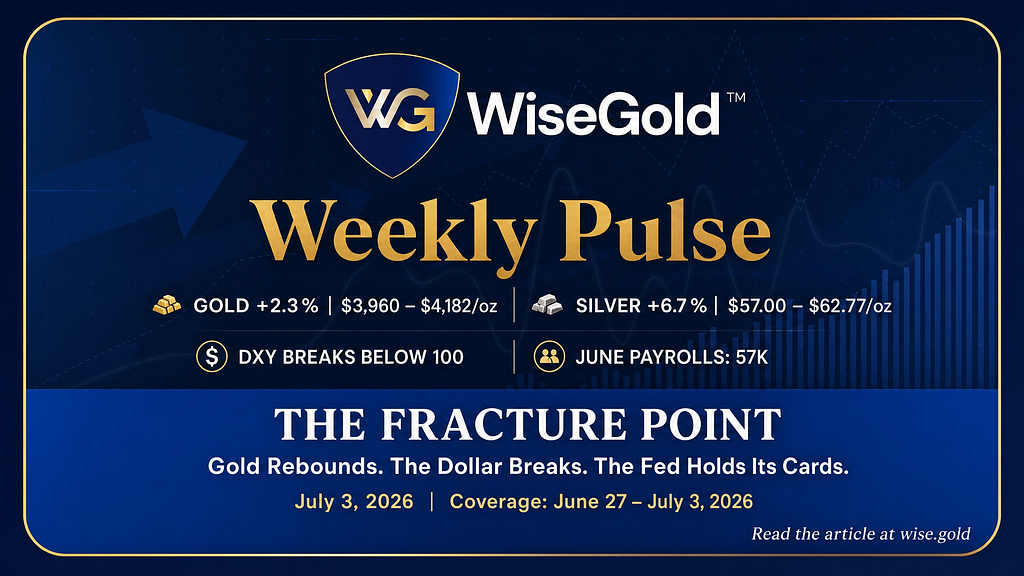
Pulso Semanal WiseGold | 3 de julho de 2026
Período de Cobertura: 27 de junho de 2026 (00:00:00 EST) a 3 de julho de 2026 (11:00:00 EST)
A WiseGold Capital faz parceria com consultores para ajudá-los a gerenciar ativos para seus clientes. A WiseGold Capital não é gestora de ativos nem consultora financeira; É uma empresa de consultoria e logística. Nada nesta publicação constitui aconselhamento de investimento.
Sobre a WiseGold
O WiseGold Weekly Pulse é publicado pela WiseGold, uma empresa de consultoria e logística que faz parcerias com consultores financeiros, family offices e gestores de fundos para facilitar o acesso a metais preciosos físicos como parte de um quadro mais amplo de preservação de patrimônio e diversificação de portfólio. Recursos adicionais, incluindo comentários de mercado de nível institucional, conteúdo educacional sobre fundamentos de metais preciosos e informações sobre os serviços de apoio de consultoria da WiseGold, estão disponíveis no https://wise.gold.
Resumo Executivo
A semana passada foi marcada por esfriamento dos mercados de trabalho, persistente cautela dos bancos centrais e alívio das tensões geopolíticas, tudo isso impulsionando a valorização entre ativos. O mercado de trabalho dos EUA apresentou uma resfriamento notável, com a folha de pagamento não agrícola em junho aumentando apenas 57.000 e a taxa de desemprego caindo para 4,2%, principalmente devido à queda na participação na força de trabalho [1]. O presidente do Federal Reserve, Kevin Warsh, falando no Fórum do BCE em Sintra, recusou-se a fornecer orientação futura sobre as taxas, mas enfatizou que a inflação continua "alta demais", mantendo um compromisso firme com a meta de 2% [2]. Enquanto isso, os preços do petróleo recuaram após um memorando de entendimento entre EUA e Irã sobre cessar-fogo que amenizou os temores de interrupções no suprimento no Estreito de Ormuz [3]. Os metais preciosos experimentaram uma ressurgência, com o ouro ultrapassando $4.100/oz e registrando seu primeiro ganho semanal em um mês, enquanto investidores reduziram as expectativas de novos aumentos das taxas do Fed [4]. O ambiente macroeconômico mais amplo sugere uma transição para um crescimento mais lento e um possível pico do dólar americano, reforçando o argumento estratégico dos metais preciosos como diversificador central de portfólio.
Principais Conclusões:
- Mercado de Trabalho Esfriando: As folhas de pagamento dos EUA em junho decepcionaram em 57.000, sinalizando uma desaceleração na criação de empregos [1].
- Fed permanece cauteloso: O presidente do Fed, Warsh, reiterou o compromisso com a inflação de 2%, resistindo aos pedidos por cortes prematuros nas taxas [2].
- Afrouxamento Geopolítico: Um Memorando de Entendimento de cessar-fogo entre EUA e Irã reduziu os riscos de fornecimento de petróleo, levando à queda nos preços do petróleo [3].
- Recuperação do ouro: Os preços do ouro subiram acima de $4.100/oz enquanto os mercados reduziram as expectativas de aumento das taxas no curto prazo [4].
- Fraqueza do Dólar: O DXY caiu abaixo da marca de 100, sinalizando uma possível mudança no ambiente global de financiamento [5].
Linha do tempo da Semana de Revisão do Mercado & Macro
- Sex 26 de junho: A inflação subjacente do PCE de maio foi registrada em 3,4%, com PCE principal em 4,1%, indicando pressões persistentes sobre preços (nota: estes dados foram divulgados de 25 a 26 de junho, mas continuaram a moldar o sentimento do mercado durante toda a semana de cobertura) [6].
- Segunda-feira, 29 de junho: A Suprema Corte dos EUA decidiu por 5 a 4 que a governadora do Fed, Lisa Cook, pode permanecer em seu cargo, afirmando a independência do banco central contra tentativas de demissão presidencial [7].
- Ter-feira, 30 de junho: O relatório da JOLTS mostrou que as vagas de emprego nos EUA permaneceram estáveis em 7,6 milhões em maio, refletindo uma demanda de mão de obra estável, mas em esfriamento [8].
- Quarta-feira, 1º de julho: O presidente do Fed, Kevin Warsh, no Fórum do BCE em Sintra, afirmou que os preços continuam "altos demais" e recusou-se a sinalizar a decisão sobre a taxa de julho [2]. A ADP relatou que o emprego no setor privado aumentou 98.000 empregos em junho, abaixo das expectativas [9]. O PMI de Manufatura do ISM registrou 53,3%, abaixo de maio, mostrando uma diminuição da atividade das fábricas [10].
- Quinta-feira, 2 de julho: O Departamento do Trabalho dos EUA relatou que as folhas de pagamento não agrícolas em junho aumentaram apenas 57.000, com a taxa de desemprego em 4,2% [1]. Os EUA recusaram-se a renovar o pacto comercial do USMCA, optando por um processo anual de revisão [11].
- Sex 3 de julho: Os mercados de ações e títulos dos EUA observaram o feriado do Dia da Independência, fechando as negociações para o fim de semana prolongado [12].
Mergulhos Temáticos Profundos
Política Macro e Monetária
Os bancos centrais continuam focados na inflação, equilibrando política restritiva com sinais de resfriamento econômico. No Fórum do BCE em Sintra, o presidente do Fed, Kevin Warsh, rejeitou firmemente a orientação futura e reiterou que o Fed não tolerará inflação acima de sua meta de 2%, apesar das pressões políticas [2].
- Warsh enfatizou o retorno aos "princípios básicos" e a dependência de dados em tempo real em vez de pesquisas convencionais [2].
- O Banco da Inglaterra manteve as taxas em 3,75%, com o governador Andrew Bailey observando que cortes de juros ainda não estão em cima da mesa [13].
- O BCE e outros grandes bancos centrais mantêm posturas restritivas enquanto a inflação subjacente se mostra persistente [2].
Dados de Inflação e Crescimento
Dados econômicos dos EUA revelaram uma clara moderação no impulso de crescimento. O relatório de empregos de junho foi uma surpresa significativa para baixo, adicionando apenas 57.000 empregos, enquanto nos meses anteriores foram revisados para baixo [1].
- A taxa de desemprego caiu para 4,2%, mas isso foi impulsionado pela redução da taxa de participação na força de trabalho, que caiu para 61,5% [1].
- A inflação subjacente do PCE de maio permaneceu elevada, em 3,4%, mantendo a pressão sobre o Fed [6].
- A atividade manufatureira diminuiu, com o PMI ISM caindo para 53,3% em junho, refletindo novos pedidos e produção mais lentos [10].
Taxas e Dinâmica da Curva de Juros
Os rendimentos do Tesouro apresentaram volatilidade, quedando após os dados fracos de emprego. A perspectiva de um aumento de juros do Fed no curto prazo diminuiu significativamente.
- O rendimento do Tesouro de 10 anos ficou em torno de 4,48%, enquanto o rendimento de 2 anos caiu para perto de 4,13% após o relatório de empregos [14].
- Os mercados em grande parte previam um aumento de juros em julho e reduziram a probabilidade de um aumento em setembro para cerca de 50–60% [1].
- A curva de juros permanece invertida, mas o front end subiu à medida que os traders ajustaram suas expectativas de política [14].
Panorama de FX & Dólar
O dólar americano enfrentou uma pressão significativa para baixo, com o índice DXY quebrando abaixo do nível psicológico 100. Essa mudança reflete mudanças nas diferenças nas taxas de juros e um esfriamento da economia dos EUA.
- O DXY negociou próximo a 100,8, estendendo uma venda ampla enquanto os mercados reavaliavam a narrativa de "taxa mais alta por mais tempo" [5].
- Um dólar mais fraco oferece um ambiente favorável para ativos de mercados emergentes e commodities denominadas em dólares [5].
- O euro e o iene apresentaram força relativa, embora a normalização da política do Banco do Japão permaneça gradual [15].
Contexto de Energia e Commodities Gerais
Os mercados de energia eram dominados por desenvolvimentos geopolíticos, especificamente pelo alívio das tensões no Oriente Médio.
- O petróleo Brent caiu para cerca de $71,57/barril, e o WTI caiu para $68,58/barril, registrando quedas mensais significativas [3].
- Um memorando de entendimento de 14 pontos entre os EUA e o Irã pausou os combates e aliviou as preocupações com os fluxos de petróleo pelo Estreito de Ormuz [3].
- Os preços do gás natural tenderam a cair, estabilizando-se perto de $3,215/MMBtu em meio a uma oferta robusta [16].
Foco em Metais Preciosos
Os metais preciosos subiram fortemente à medida que o dólar americano enfraqueceu e as expectativas de aumento de juros se moderaram. O setor demonstrou resiliência após um segundo trimestre desafiador, com os quatro metais registrando ganhos na semana.
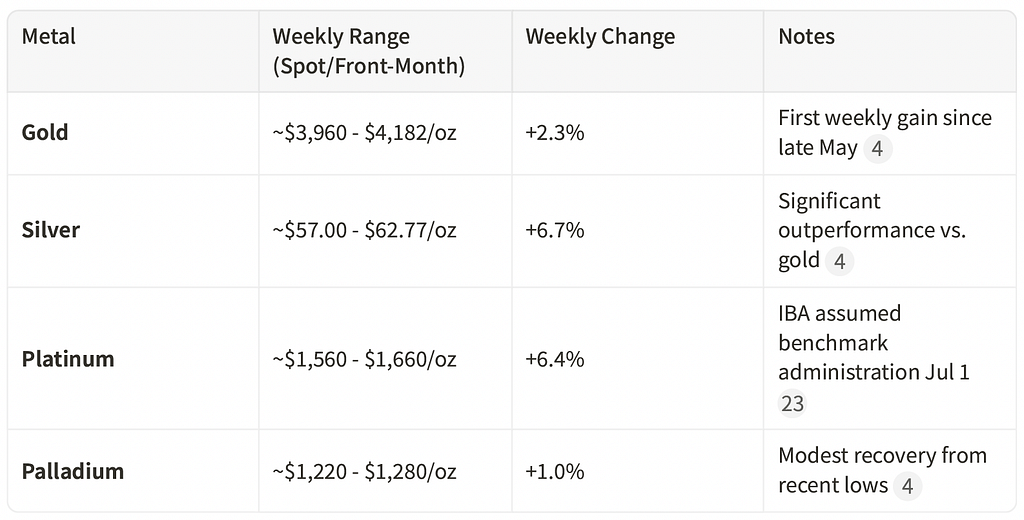
- Dados de posicionamento do relatório COT (em 23 de junho de 2026) mostraram grandes especuladores detendo posições líquidas longas de aproximadamente 181.339 contratos em futuros de ouro, refletindo o sentimento otimista contínuo apesar da recente fraqueza de preço [17].
- Os dados de posicionamento da prata mostraram que grandes especuladores têm posições líquidas compradas em aproximadamente 23.751 contratos [17].
- Os fluxos de tonelagem dos ETFs para a semana encerrada em 3 de julho de 2026 não foram totalmente publicados dentro do período de cobertura. [Verificação necessária]
- Demanda de ouro dos bancos centrais: Nenhuma nova evidência verificável de compras do banco central foi publicada dentro do período de cobertura. A pesquisa anual do Conselho Mundial do Ouro (publicada em junho de 2026) observou que mais bancos centrais globais estão posicionados para aumentar as reservas de ouro ao longo do próximo ano [21].
Crédito e Liquidez
Os mercados de crédito permaneceram relativamente estáveis, embora o fraco relatório de empregos tenha provocado uma reavaliação dos fundamentos corporativos.
- Os rendimentos dos títulos corporativos de grau de investimento ficaram em 5,19%, com um spread de 0,76% sobre os títulos do Tesouro [18].
- Os spreads de alto rendimento permanecem contidos, mas uma desaceleração econômica sustentada pode levar ao alargamento da expansão.
- As condições de liquidez são adequadas, embora o aperto quantitativo contínuo do Fed continue drenando reservas do sistema.
Sentimento de Ações e Volatilidade
As ações dos EUA tiveram uma semana mista, equilibrando dados econômicos mais fracos com a perspectiva de taxas de juros mais baixas.
- O S&P 500 fechou próximo a 7.483, mostrando pequenas quedas enquanto as ações de tecnologia enfrentavam lucros [19].
- O índice VIX permaneceu relativamente moderado em torno de 16,45, indicando que os mercados de ações ainda não precificaram riscos significativos de recessão [20].
- Os volumes de negociação estavam mais leves antes do feriado de 4 de julho [12].
Geopolítica & Risco Estratégico
Os riscos geopolíticos se moderaram levemente com o cessar-fogo entre EUA e Irã, mas as incertezas estruturais permanecem altas.
- O MoU EUA-Irã proporcionou alívio temporário aos mercados de energia, mas a situação permanece frágil [3].
- A decisão dos EUA de não renovar o pacto comercial do USMCA introduz incerteza de longo prazo nas relações comerciais da América do Norte [11].
- As próximas eleições de meio de mandato nos EUA são cada vez mais vistas como uma fonte de volatilidade política [21].
Temas Estruturais e de Longo Prazo
Temas estruturais de longo prazo continuam a moldar o cenário macro, especialmente o impacto da inteligência artificial e da sustentabilidade fiscal.
- O investimento de capital impulsionado por IA está apoiando o crescimento econômico, mas seus amplos benefícios de produtividade ainda estão se materializando [22].
- Déficits fiscais dos EUA e a sustentabilidade da dívida continuam sendo uma preocupação central para investidores de títulos de longo prazo, apoiando o argumento estrutural para ativos reais [22].
- As tendências de desdolarização, embora graduais, continuam a apoiar a acumulação de ouro dos bancos centrais como estratégia de diversificação [15].
Interconexões entre Ativos
- Empregos mais fracos -> rendimentos menores -> Ouro mais alto: O relatório decepcionante de folhas de pagamento de junho levou a uma queda nos rendimentos dos títulos do Tesouro de curto prazo, reduzindo o custo de oportunidade de manter ouro sem rendimento e elevando os preços acima de $4.100/oz.
- Afrouxamento Geopolítico - > Redução do Petróleo -> Redução dos Medos de Inflação: O MoU de cessar-fogo EUA-Irã causou queda nos preços do petróleo bruto, o que pode ajudar a moderar a inflação geral nos próximos meses, dando mais flexibilidade aos bancos centrais.
- Fraqueza do Dólar - > Suporte amplo de commodities: O DXY caiu abaixo de 100 proporcionou um vento favorável para commodities em geral, especialmente metais preciosos, tornando-as mais baratas para os países fora dos EUA. compradores.
- Inflação Núcleo Persistente -> Banco Central Cautela: Apesar dos dados de crescimento mais fracos, a inflação elevada do PCE subjacente (3,4%) mantém o Fed e o BCE cautelosos, impedindo uma rápida mudança para cortes de juros e mantendo os rendimentos reais relativamente altos.
Snapshot da Matriz de Risco
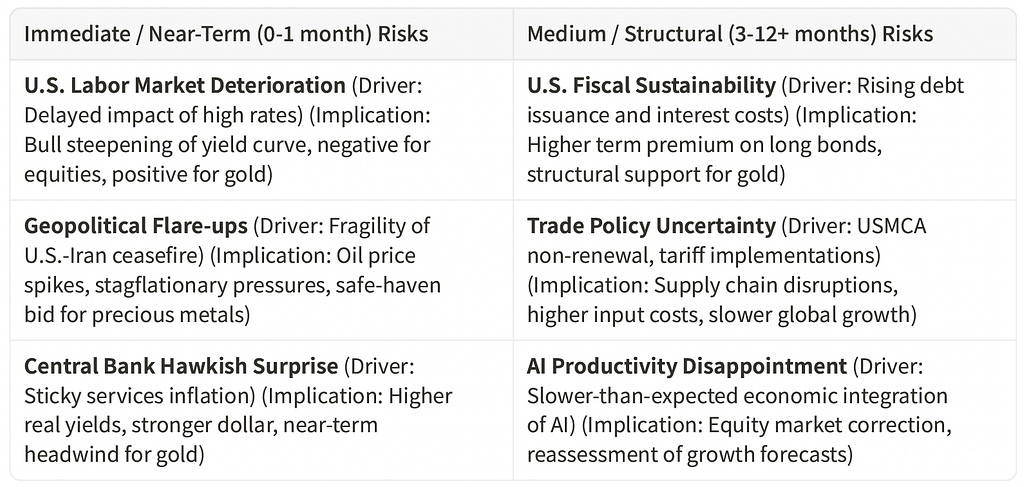
Observação de Cenários & Catalisadores Avançados
- Divulgação de Dados do IPC dos EUA (meados de julho): [Probabilidade Base] Espera-se que apresente moderação gradual. Um resultado mais quente do que o esperado reviveria os temores de aumento das taxas, apresentando um vento contrário no curto prazo para o ouro precioso.
- Reunião do FOMC (28–29 de julho): [Probabilidade Base] Espera-se que mantenha as taxas estáveis. Os mercados vão analisar a declaração em busca de quaisquer mudanças no equilíbrio de riscos entre inflação e emprego.
- Quebra do cessar-fogo EUA-Irã: [Probabilidade Elevada] Dadas as tensões históricas, a retomada das hostilidades rapidamente faria os preços do petróleo disparar e impulsionaria fluxos de refúgio para ouro e dólar.
- Revisão Significativa para Baixa do PIB do segundo trimestre: [Baixa Probabilidade] Uma contração acentuada no crescimento forçaria o Fed a pivotar para o dovish, levando a uma rápida desvalorização do dólar e a uma forte alta dos metais preciosos.
Contexto e Implicações do Portfólio
O atual ambiente macroeconômico, caracterizado por crescimento desacelerado, inflação persistente e riscos geopolíticos elevados, ressalta a importância de uma construção robusta de portfólios. A recente quebra do dólar americano e o esfriamento do mercado de trabalho sugerem que o pico da política monetária restritiva pode ter passado. Nesse contexto, ativos que oferecem retornos não correlacionados e proteção contra desvalorização da moeda tornam-se cada vez mais valiosos. A resiliência dos metais preciosos durante o recente período de altos rendimentos reais destaca sua demanda estrutural subjacente. À medida que as correlações tradicionais entre ações e títulos enfrentam desafios em um ambiente potencialmente estagflacionário, ativos reais e diversificadores alternativos podem desempenhar um papel crucial na mitigação da volatilidade da carteira e na preservação do poder de compra a longo prazo.
Tese Estratégica sobre Metais Preciosos
Atributo de Diversificação
A baixa correlação do ouro com ativos tradicionais de risco o torna um diversificador vital. Durante períodos de estresse no mercado de ações ou mudanças nas expectativas de política monetária, o ouro frequentemente oferece uma força estabilizadora, reduzindo a volatilidade geral da carteira.
Proteção de Patrimônio e Poder de Compra
À medida que as moedas fiduciárias enfrentam pressões de longo prazo de políticas fiscais expansivas e níveis crescentes de dívida, os metais preciosos servem como uma reserva comprovada de valor. A capacidade histórica do ouro de manter o poder de compra o torna uma proteção crítica contra a inflação e a desvalorização da moeda.
Mitigação de Redução de Impacto e Opcionalidade de Crise
Em tempos de crise geopolítica aguda ou estresse sistêmico financeiro, o ouro apresenta fortes características de refúgio seguro. A recente ação dos preços durante as tensões no Oriente Médio demonstra a utilidade do ouro para mitigar quedas severas de portfólio.
Fatores de Demanda Estrutural
Além dos fluxos de investimento, o ouro se beneficia de uma demanda estrutural robusta. Os bancos centrais continuam acumulando reservas de ouro para diversificar longe do dólar americano, enquanto a demanda física dos mercados asiáticos (particularmente China e Índia) oferece um piso fundamental forte para os preços.
Estrutura de Alocação
Pesquisas acadêmicas e análises históricas de desempenho sugerem que uma alocação estratégica em metais preciosos pode aumentar os retornos ajustados ao risco de uma carteira diversificada. Embora a alocação ideal varie conforme o perfil do investidor, a inclusão de ouro e prata fornece uma camada fundamental de resiliência financeira.
Cápsula Resumo
- Pulso Macro: O mercado de trabalho dos EUA esfria significativamente (57 mil empregos adicionados em junho), sinalizando uma possível desaceleração econômica.
- Posição dos Metais: O ouro ultrapassa $4.100/oz, registrando seu primeiro ganho semanal em um mês enquanto as expectativas de aumento de juros recuam.
- Tom de Risco: Os mercados de ações permanecem próximos aos máximos, mas mostram sinais de fadiga; O VIX permanece contido apesar das mudanças econômicas subjacentes.
- Nuance de posicionamento: Dados do COT indicam que grandes especuladores estão aumentando posições líquidas longas no ouro, refletindo um novo momento otimista.
- Observação Futura: O foco se volta para os próximos dados do IPC dos EUA e para a reunião do FOMC no final de julho para esclarecer a trajetória de política do Fed.
- Tema Estrutural: Déficits fiscais persistentes dos EUA e tendências globais de desdolarização fornecem suporte estrutural de longo prazo para metais preciosos.
Lista de Fontes
[1] Reuters — Crescimento do emprego nos EUA desacelera em junho; Taxa de desemprego cai para 4,2% em meio à queda na força de trabalho — 2 de julho de 2026 — https://www.reuters.com/world/us/us-job-growth-misses-expectations-june-unemployment-rate-falls-42-2026-07-02/ [2] CNBC — O chefe do Fed, Kevin Warsh, recusa dar pistas sobre decisão sobre a taxa em julho, mas diz que a inflação está 'alta demais' — 1º de julho de 2026 — https://www.cnbc.com/2026/07/01/kevin-warsh-ecb-forum-live-updates.html [3] CNBC — Preços do petróleo caem após Trump afirmar que as negociações EUA-Irã no Catar estão indo bem — 1º de julho de 2026 — https://www.cnbc.com/2026/07/01/oil-prices-brent-wti-crude-trump-iran.html [4] CNBC — Os preços do ouro estão programados para a primeira alta semanal em um mês enquanto investidores reduzem apostas de aumento de juros do Fed — 3 de julho de 2026 — https://www.cnbc.com/2026/07/03/gold-silver-price-inflation-fed-rate-hike.html [5] Mercados E8 — Quebra do Dólar: O que o DXY Abaixo de 100 Significa para Câmbio, Ações e Commodities — 2 de julho de 2026 — https://blog.e8markets.com/article/dollar-breakdown-what-dxy-below-100-means-for-fx-stocks-and-commodities [6] Forum Nadlan — Inflação Núcleo atinge 3,4% em maio de 2026 — 26 de junho de 2026 — https://www.forumnadlanusa.com/2026/06/core-pce-inflation-may-2026/ [7] Reuters — Warsh, do Fed, promete 'decepcionar' qualquer um que ache que tolerará inflação acima de 2% — 1º de julho de 2026 — https://www.reuters.com/world/europe/warsh-hits-international-stage-with-peers-sharing-an-inflation-problem-2026-07-01/ [8] Bureau of Labor Statistics — Vagas de Emprego e Rotatividade Laboral Resumo — Resultados M05 de 2026 — 30 de junho de 2026 — https://www.bls.gov/news.release/jolts.nr0.htm [9] ADP — Relatório Nacional de Emprego da ADP: O emprego no setor privado aumentou 98.000 empregos em junho — 1º de julho de 2026 — https://mediacenter.adp.com/2026-07-01-ADP-National-Employment-Report-Private-Sector-Employment-Increased-by-98,000-Jobs-in-June-Annual-Pay-was-Up-4-4 [10] PR Newswire — PMI® de manufatura em 53,3%; Relatório PMI® de Manufatura do ISM de junho de 2026® — 1º de julho de 2026 — https://www.prnewswire.com/news-releases/manufacturing-pmi-at-53-3-june-2026-ism-manufacturing-pmi-report-302814991.html [11] TEMPO — OS EUA recusam renovar o pacto comercial com México e Canadá — 2 de julho de 2026 — https://time.com/article/2026/07/02/us-declines-renewal-trade-pact-mexico-canada-impact/ [12] MarketWatch — Quando os mercados fecham para o feriado de 4 de julho? — 2 de julho de 2026 — https://www.wsj.com/livecoverage/june-jobs-report-stock-market-07-02-2026/card/when-are-markets-closed-for-the-july-4th-holiday--3PNB1UAZIOT7jR4TK3E8 [13] Reuters — Cortes de juros não voltaram à mesa para a Grã-Bretanha, diz Bailey, do Banco da Inglaterra, em 1º de julho de 2026 — https://www.reuters.com/world/uk/rate-cuts-are-not-back-table-britain-bank-englands-bailey-says-2026-07-01/ [14] CNBC — Rendimento do Tesouro de 2 anos diminui enquanto relatório de empregos leves reduz as expectativas de aumento do Fed — 2 de julho de 2026 — https://www.cnbc.com/2026/07/02/us-treasury-yields-rise-as-investors-await-june-jobs-report.html [15] Morningstar — A Alta do Dólar Americano Continuará? — 3 de julho de 2026 — https://global.morningstar.com/en-nd/markets/will-us-dollar-rally-continue [16] Sprague Energy — Tendências de Contratos de Gás Natural Analisadas para julho — 2 de julho de 2026 — https://www.spragueenergy.com/august-nymex-natural-gas-futures-contract-closed-at-3-220-on-wednesday-july-1st/ [17] GoldSeek — Relatório COT Gold, Silver & USDX — 26 de junho de 2026 — 26 de junho de 2026 — https://goldseek.com/article/cot-gold-silver-usdx-report-june-26-2026 [18] StreetStats — Títulos Corporativos — Taxas de Juros de Títulos de Grau de Investimento e Alto Rendimento — 30 de junho de 2026 — https://streetstats.finance/rates/corporates [19] Yahoo Finance — Notícias do Mercado de Ações de 2 de julho de 2026 — 2 de julho de 2026 — https://finance.yahoo.com/markets/stocks/articles/stock-market-news-july-2-132600808.html [20] FRED — Índice de Volatilidade CBOE: VIX — 3 de julho de 2026 — https://fred.stlouisfed.org/series/VIXCLS [21] Conselho Mundial do Ouro — Perspectivas do Meio de Ano do Ouro 2026: Quebra de pontos — 1º de julho de 2026 — https://www.gold.org/goldhub/research/gold-mid-year-outlook-2026 [22] iCapital — iCapital Market Pulse: As Maiores Surpresas da Economia da IA — 26 de junho de 2026 — https://icapital.com/insights/investment-market-strategy/icapital-market-pulse-the-ai-economys-biggest-surprises/ [23] LBMA — IBA administrará os Indicações de Preços de Platina e Palládio da LBMA de 1º de julho de 2026 — 1º de julho de 2026 — https://www.lbma.org.uk/articles/iba-to-administer-lbma-platinum-and-palladium-price-benchmarks-from-1-july-2026
Pendente de Verificação
- O volume exato das compras de ouro pelos bancos centrais em junho de 2026, já que os dados mensais abrangentes não foram totalmente publicados dentro do período de cobertura.
- Os fluxos específicos de tonelagem do ETF para GLD e outros grandes ETFs de ouro para a semana exata encerrada em 3 de julho de 2026.
- Os dados mais recentes do relatório COT até 3 de julho de 2026, já que a CFTC normalmente publica o relatório às sextas-feiras; o relatório de 26 de junho de 2026 (posições até 23 de junho) foi o mais recente disponível dentro do período de cobertura.
Metodologia e Notas
- Compilação de Dados: Os dados foram coletados de fontes financeiras confiáveis, publicações de bancos centrais e provedores de dados de mercado cobrindo o período de 27 de junho de 2026 (00:00:00 EST) a 3 de julho de 2026 (11:00:00 EST).
- Faixas de Preço: Os preços dos metais preciosos são aproximados com base nos dados de mercado à vista disponíveis durante a janela de cobertura.
- Convenções de Carimbo de Hora: Todos os horários referenciados são no Horário Padrão do Leste (EST), salvo indicação em contrário. Divulgações de dados às sextas-feiras, às 10h00 EST, como o relatório ISM Manufacturing PMI e JOLTS (do início da semana), são incorporadas.
Divulgação
Este relatório é apenas para fins informativos e não constitui aconselhamento de investimento, recomendação, oferta ou solicitação para comprar ou vender qualquer instrumento financeiro. As opiniões expressas baseiam-se em informações publicamente disponíveis que se acredita serem confiáveis, mas a precisão ou completude não pode ser garantida. O desempenho passado não indica resultados futuros. Os leitores devem realizar sua própria análise e consultar profissionais qualificados antes de tomar qualquer decisão financeira.
#WiseGold #PreciousMetals #Gold #Silver #WiseGold #MacroOutlook #WealthProtection #PortfolioDiversification #FinancialResilience #GoldMarket #WeeklyPulse #CentralBanks #Inflation #FederalReserve #MarketIntelligence #RealAssets #WiseGoldCapital